
Agroforestry systems, such as alley cropping systems, are land-use systems that integrate tree species with agricultural crops on the same land area. They represent a sustainable approach to natural resource management and are increasingly important worldwide. According to the International Centre for Research in Agroforestry (ICRAF), about 43% of global agricultural land has more than 10% tree cover, highlighting the widespread use of this approach. In Europe, agroforestry covers about 15.4 million hectares (3.6% of land area or 8.8% of agricultural land), although alley-cropping systems combining trees and arable crops account for only about 0.2% of farmland.
Agroforestry provides numerous ecological and agronomic benefits, including improved soil structure and fertility, reduced nutrient and pesticide leaching, lower erosion, and enhanced nutrient cycling. Trees also contribute to climate-change mitigation by increasing carbon sequestration and nitrogen fixation. In Europe, a common model is alley cropping, where rows of trees such as poplar, willow, or black locust alternate with annual crops. Studies from several European countries show that such systems can improve resource use efficiency and stabilize production, although crop yields may be slightly lower than in treeless systems.
Despite these benefits, agroforestry systems require careful design and management, as interactions between trees and crops can be both positive and negative. Factors such as shade, light quality, and resource competition influence plant growth, physiology, and yield. Understanding the ecophysiological responses of crops to shading and microclimatic changes is therefore essential for selecting species that perform well in integrated systems and for guiding future crop breeding.
Agroforestry also supports soil health and biodiversity. The presence of trees can increase microbial biomass, beneficial bacteria, fungi, and nematodes, improving soil functioning and resilience. Microbial biomass is a key indicator of soil fertility and environmental change, while soil nematodes serve as useful indicators of soil biodiversity and ecosystem stability.
Additionally, trees influence microclimatic conditions, which is particularly important in regions increasingly affected by climate extremes. By moderating temperature, reducing soil moisture loss, and creating more stable growing conditions, agroforestry systems can enhance crop resilience and ecosystem balance.
For these reasons, interest in integrating tree species into agricultural landscapes is growing. Such systems can improve microclimate, stabilize soil conditions, and maintain biodiversity, while contributing to the development of climate-resilient and sustainable agricultural systems.
Experimental Setup
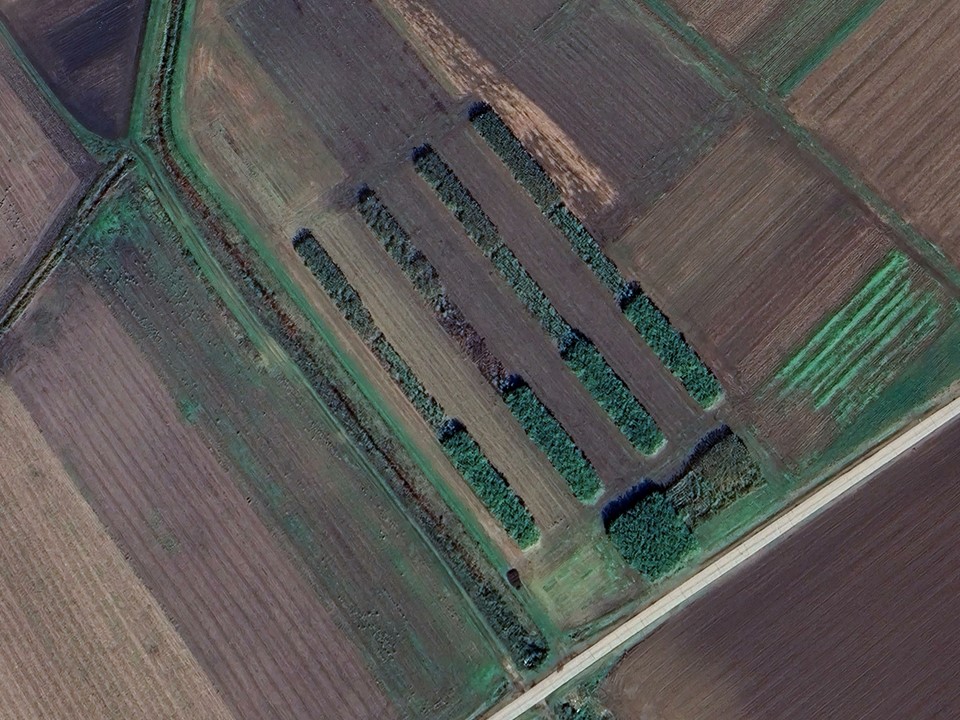
Within the project, observations will be conducted at the “Tenja” experimental field of the Faculty of Agrobiotechnical Sciences Osijek on an existing alley-cropping system established in 2021, combining field crops with short-rotation woody species (black locust, willow, and poplar). A control treatment with field crops located several hundred meters away will also be monitored.
The experimental area covers about 2.5 ha and includes four protective tree belts. Each belt is 8 m wide and 150 m long (50 m per species) and consists of six rows of trees. The belts differ by soil conditions and mulch treatments:
The belts are separated by 24 m strips used for crop production.
Short-rotation trees are managed by cutting every 3–5 years, after which they regenerate from the root. At the start of the study the belts will be four years old, and a harvest is planned for autumn 2025, initiating a new rotation cycle while continuing long-term soil monitoring. Because soil effects of short-rotation crops often appear after 5–10 years, additional treatments will include wood-chip incorporation in crop areas on both degraded and fertile soils to accelerate soil organic matter increase.
Agroclimatological Measurements
Microclimatic conditions will be monitored using meteorological stations placed within the alley-cropping system and a control station outside the system. Stations (installed at about 1.5 m height) will measure wind speed and direction, precipitation, air temperature, humidity, and solar radiation.
Additional sensors (EBRO devices) will measure temperature and humidity 50 cm above the crop canopy. Sensors will be placed within the poplar belt, near the belt edge, in the middle of the crop alley, and outside the system as controls.
Soil Analyses
Physical and chemical soil properties will be analyzed within tree belts and crop alleys during the growing season. Soil samples will be collected at 0–30 cm and 30–60 cm depths after each season.
The following parameters will be determined:
Additional physical properties will include soil porosity, compaction (penetrometer), water permeability, and soil water retention (pF). All analyses will follow ISO standards and Croatian regulations and will be performed at the Central Laboratory of the Faculty of Agrobiotechnical Sciences Osijek.
Plant Analyses (Trees and Crops)
Biomass yield of short-rotation trees will be assessed by measuring diameter at breast height, stem circumference, tree height, and fresh mass of representative trees. Sample preparation will follow HRN EN 14778:2011, while ash content and dry matter will be determined according to ISO standards.
Crop yields will be determined at harvest and before incorporation of green-manure crops. Yield will be measured from several sample plots within each alley:
The remaining area will be harvested by combine. Grain yield will be expressed in kg/ha at standardized moisture, and grain quality will be measured using an InfratecTM 1241 analyzer. Additional measurements on selected plants will include harvest index, yield components, and agronomic traits.
Ecophysiological parameters of crops will also be monitored over three growing seasons, including:
Leaf samples will be collected several times during sensitive growth stages. After statistical analysis, physiological data will be integrated with climate data and yield results. Analyses will be conducted at the Agroecology Laboratory of the Faculty of Agrobiotechnical Sciences Osijek and the Agricultural Institute Osijek.
Nematological Analyses
Nematode communities will be analyzed from soil samples taken in tree belts and crop alleys during the growing season. Soil samples will be collected at 0–30 cm depth in four replicates.
Nematodes will be extracted using the Baermann funnel method, counted under a stereomicroscope, and identified to genus level (at least 100 individuals per sample). Community structure, trophic groups, biodiversity, and ecological indices (MI, PPI, EI, SI, CI) will be calculated to assess soil ecosystem condition.
Microbiological Analyses
Soil microbiological analyses will be conducted during the growing season using the same soil samples as for nematode analyses to allow comparison. Samples will be stored at 4 °C until laboratory analysis.
Soil microbial biomass will be determined using the fumigation–extraction method (ISO 14240-2). Each sample will be divided into two subsamples: one fumigated with chloroform and one control. After extraction with K₂SO₄, carbon concentration will be measured spectrophotometrically. Microbial biomass will be calculated from the difference between fumigated and control samples and expressed as kg ha⁻¹, serving as an indicator of soil fertility and soil health.